
What Does “KPSI” Mean and Does it Matter?
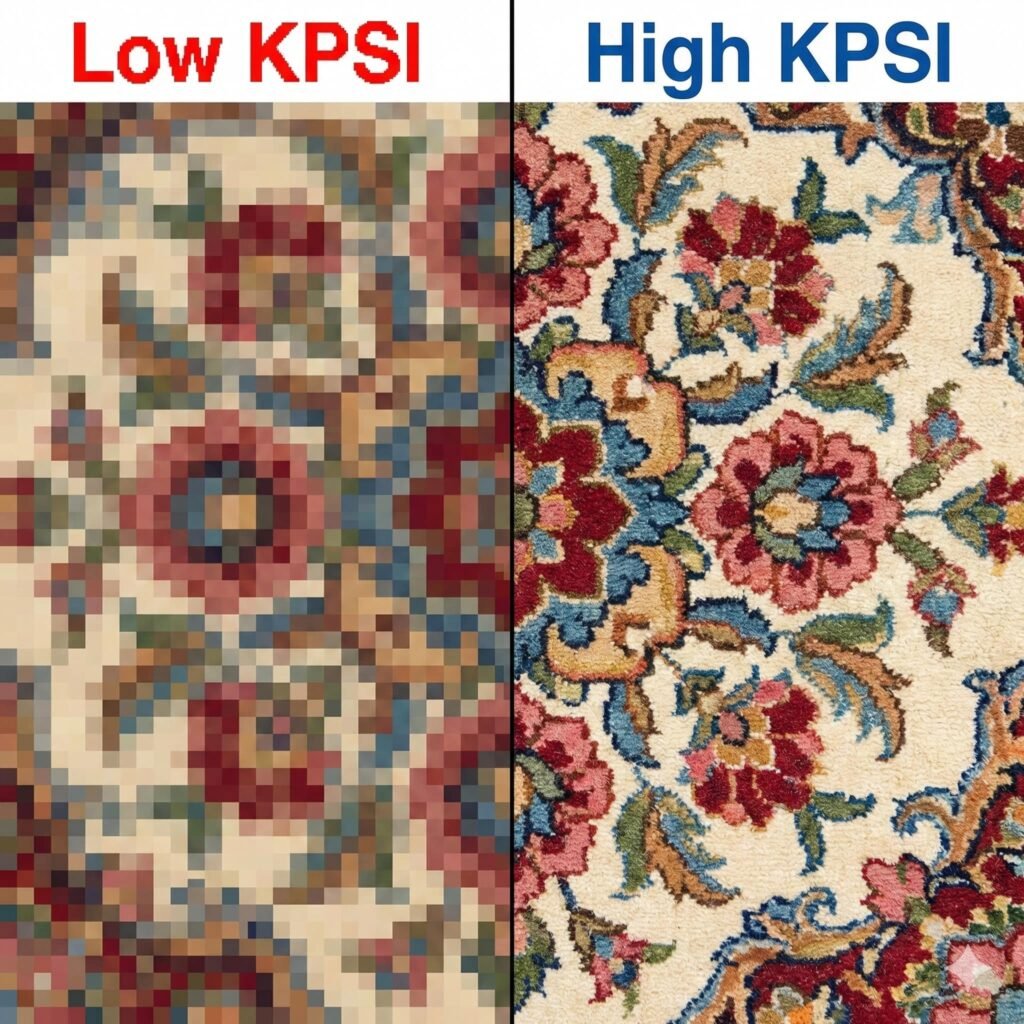
KPSI stands for Knots Per Square Inch. It is a unit of measurement used to determine the density of a hand-knotted rug. You calculate it by counting the number of knots in a one-inch vertical line and multiplying it by the number of knots in a one-inch horizontal line on the back of the rug. While a higher KPSI typically indicates a more intricate design and higher labour costs, it does not automatically guarantee superior quality. The value of KPSI depends on the rug's style; it is crucial for detailed, curvilinear floral patterns but less important for geometric, tribal designs.
- By Mehdi Sharafi
- Last updated: January 14, 2026
Quick Summary: KPSI at a Glance
| Feature | Low to Medium KPSI (30–100) | High to Very High KPSI (250–1000+) |
| Best For | Geometric, tribal, and bold patterns | Intricate curves, floral motifs, and realistic portraits |
| Texture | Often thicker, plush, and softer underfoot | Thinner, tighter, and very firm |
| Durability | High (if good wool is used); handles traffic well | High, but often treated as delicate art pieces |
| Cost | More affordable (less labour time) | Expensive (thousands of hours of labour) |
| Typical Materials | Thick wool, cotton foundation | Fine wool, silk, silk-on-silk |
| Key Takeaway | Good for casual, daily living spaces | Best for investment pieces and formal areas |
What Does “KPSI” Mean and Does it Matter?
When you start shopping for high-quality carpets, specifically hand-knotted Oriental or Persian rugs, you will immediately encounter the term KPSI. Sellers often use high KPSI numbers as a major selling point, implying that a higher number always equals a better rug.
However, the reality is more nuanced. KPSI is a measure of density and intricacy, not necessarily a direct measure of longevity or beauty. Understanding how it works will protect you from overpaying for specifications you do not need and help you find the right rug for your home.
What Exactly is KPSI?
KPSI stands for Knots Per Square Inch. It is the standard industry metric for measuring the weave density of a hand-knotted rug.
Think of a rug like a digital photograph. In a photo, the resolution is measured in pixels. The more pixels you have, the clearer and more detailed the image is. If you have very few pixels, the image looks blocky and jagged.
- Knots are the pixels of the rug world.
- A rug with a high KPSI can display very fine details, smooth curves, and elaborate shadings.
- A rug with a low KPSI will have a blockier, more geometric look.
The knot count is determined by the craftsman tying individual pieces of wool or silk around the warp strings (the vertical foundation threads). The finer the thread and the closer the warp strings are packed together, the more knots can be squeezed into a single square inch.
How to Calculate KPSI Yourself
You do not need to rely solely on the tag attached to the rug. You can verify the quality yourself with a simple ruler. This is a useful skill when browsing antique shops or markets where labels might be missing or inaccurate.
- Flip the rug over: You count knots on the back of the rug, where the pattern of the weave is clearly visible.
- Measure Vertical Knots: Lay your ruler vertically against the grain. Count each “bump” or node you see within one inch (2.54 cm).
- Measure Horizontal Knots: Lay your ruler horizontally. Count the nodes within one inch.
- Multiply: Multiply the vertical count by the horizontal count.
Example Calculation:
- Vertical count: 10 knots
- Horizontal count: 10 knots
- Total KPSI: 10 x 10 = 100 KPSI
Does KPSI Actually Matter?
The short answer is: Yes, but it depends on the style of the rug.
KPSI matters immensely for certain designs and is irrelevant for others. To judge if KPSI matters for the specific rug you are looking at, you must identify the design category.
1. Curvilinear and Floral Designs (KPSI Matters)
If you are looking at a classic Persian city rug (like a Tabriz, Nain, or Isfahan) featuring swirling vines, perfect circles, or realistic flowers, KPSI is critical.
- To make a curve look smooth rather than like a staircase, you need many tiny knots.
- Low KPSI in these designs makes the flowers look distorted or blocky.
- Verdict: Look for high KPSI (200+).
2. Geometric and Tribal Designs (KPSI Matters Less)
Tribal rugs (like Kazak, Heriz, or Kilims) rely on bold shapes, triangles, and diamonds.
- Straight lines and diagonals do not require high density to look good.
- These rugs are often woven with thicker wool, which naturally results in fewer knots per inch.
- A low knot count here is not a flaw; it is a characteristic of the authentic style.
- Verdict: Low to Medium KPSI (60–100) is perfectly acceptable.
The Relationship Between KPSI and Durability
There is a common myth that a higher knot count makes a rug indestructible. This is not entirely true.
The Argument for Density:
A tighter weave (high KPSI) creates a dense pile that stands up straight. This density prevents dirt and grit from sinking deep into the foundation of the rug, where it can damage the fibres. In this sense, a tight weave helps preserve the rug.
The Argument for Materials:
Durability is determined more by the quality of the wool than the number of knots.
- A rug with 500 KPSI made of dry, brittle, cheap wool will wear out faster than a rug with 80 KPSI made of high-quality, lanolin-rich mountain wool.
- Tribal rugs with low knot counts have survived for over a century because the wool used was robust and thick.
Summary: Do not buy a high KPSI rug solely for durability. Buy it for the clarity of the design.
Standard KPSI Ranges
It helps to know what counts as “high” or “low” in the market. Note that these numbers apply to wool and cotton rugs. Silk rugs will always be higher.
Coarse Weave (30 – 80 KPSI)
- Typical Styles: Tribal rugs, nomadic weavings, Gabbeh rugs from India or Iran.
- Characteristics: Thick pile, soft, casual look.
- Cost: Most affordable.
Medium Weave (90 – 150 KPSI)
- Typical Styles: Many village rugs (like Heriz or Hamadan), high-quality Tibetan rugs.
- Characteristics: Good definition for geometric patterns, very durable for family rooms.
- Cost: Moderate.
Fine Weave (160 – 280 KPSI)
- Typical Styles: City rugs like Kashan, Sarouk, or some modern designer rugs.
- Characteristics: Capable of intricate curves and floral motifs. The pile is usually cut shorter to show off the design.
- Cost: High.
Extra Fine Weave (300 – 1000+ KPSI)
- Typical Styles: Isfahan, Qum, Nain, and pure silk rugs.
- Characteristics: extremely detailed, paper-thin, often suitable for hanging on walls rather than walking on.
- Cost: Investment grade (Very Expensive).
Material Matters: Wool vs. Silk
You cannot fairly compare the KPSI of a wool rug to a silk rug.
Wool is a thick fibre. There is a physical limit to how many wool knots you can pack into an inch before the rug becomes too stiff or bulky. A wool rug with 300 KPSI is an incredible feat of craftsmanship.
Silk is as fine as human hair. Weavers can tie incredibly tiny knots with silk. A silk rug might easily reach 600 or 800 KPSI.
Comparison Rule:
- If a dealer tells you a wool rug has 800 KPSI, be sceptical. It is likely silk or mercerised cotton, or the count is exaggerated.
- Always compare “apples to apples”: compare wool to wool, and silk to silk.
Why High KPSI Costs More
The price difference is strictly mathematical. It comes down to time.
Let’s look at the numbers for a standard 9×12 foot rug (which contains 15,552 square inches).
- At 100 KPSI: The rug contains roughly 1.5 million knots. A fast weaver can tie 6,000 to 8,000 knots a day. This rug takes roughly 6 months for one person to weave.
- At 400 KPSI: The rug contains roughly 6.2 million knots. This same rug now takes over 2 years to weave.
When you buy a high KPSI rug, you are paying for the years of human life invested in tying those millions of tiny knots by hand.
Common Tricks and Misconceptions
When shopping, watch out for these common misunderstandings regarding knot counts.
1. The “Double Knot” Confusion
Some regions use a measurement system that counts the warp threads rather than the knots, or they count a knot twice (once for each bump on the back). This can artificially double the KPSI number. Always ask the seller: “Is this KPSI or just the knot count?” and “Are you counting individual knots?”
2. Jufti Knots (The Cheater’s Knot)
To speed up production, some weavers use a “Jufti” knot. Instead of tying the wool around two warp strings (the standard), they tie it around four.
- This cuts the work in half.
- It cuts the density in half.
- It results in a rug that looks fine when new but is loose and wears out quickly.
- How to spot it: Poke your fingers into the pile. If it feels loose or you can easily separate the tufts to see the foundation, it might be Jufti work.
3. Machine-Made “Fake” KPSI
Machine-made rugs can simulate high density. They can produce millions of points per square meter in minutes. Do not confuse machine density with hand-knotted value. A machine-made rug with high density is still worth a fraction of a hand-knotted rug with lower density.
Factors That Influence Knot Count
Several technical elements dictate how high the KPSI can go.
The Foundation (Warp and Weft)
The foundation consists of the vertical strings (warp) and horizontal strings (weft). If the warp strings are thick cotton, you cannot tie tiny knots around them. High KPSI rugs require very fine cotton or silk warps.
The Knot Type
There are two main types of knots used in Oriental rugs:
- Ghiordes Knot (Symmetrical / Turkish): Used in Turkey and the Caucasus. It is slightly bulkier, often resulting in lower KPSI but a very strong weave.
- Senneh Knot (Asymmetrical / Persian): Used in Iran, India, and Pakistan. It is finer and allows for tighter packing, usually resulting in higher KPSI numbers.
When Should You Pay for High KPSI?
To decide if you should invest in high KPSI, use this checklist.
Buy High KPSI (200+) if:
- You want a rug with lifelike details, people, animals, or complex floral scenery.
- You are buying a rug as a financial investment or heirloom.
- You prefer a thin, firm rug that lies very flat.
- The rug will be placed in a formal living area or a low-traffic zone (to preserve the fine pile).
Buy Medium/Low KPSI (60–150) if:
- You love the look of bold, geometric, or tribal patterns.
- You want a rug that feels thick and plush under your feet.
- You have a limited budget but still want a genuine hand-knotted piece.
- The rug is for a high-traffic family room or hallway where comfort and utility matter most.
Conclusion
KPSI is a useful metric, but it is not a score of “good vs. bad.” It is simply a measure of “fine vs. coarse.”
A coarse rug with a beautiful tribal design and lustrous wool is a masterpiece in its own right, just as a finely woven city rug is. Do not get hung up on the numbers game. Use KPSI to understand the price and the clarity of the design, but ultimately, buy the rug that appeals to your eyes and feels right for your home.
If you are looking for a rug that will handle muddy boots and heavy furniture, a lower KPSI tribal rug is likely your best friend. If you want a piece of art for your formal sitting room, look for those high numbers.