

Key Summary
| Feature | Details |
| Can you layer? | Yes, it is a popular interior design choice. |
| Main Benefit | Adds warmth, defines zones, and hides worn carpet areas. |
| Main Challenge | “Rug creep” or rippling caused by the carpet pile shifting. |
| Essential Tool | Anti-slip underlay (specifically for use on carpet). |
| Best Rug Type | Heavier Persian rugs with a firm backing work best. |
| Furniture Strategy | Place front legs of sofas or beds on the rug to anchor it. |
Can I Put a Persian Rug on Top of a Fitted Carpet?
Many homeowners in the UK face a common dilemma: they have neutral, practical fitted carpets (wall-to-wall) but desire the elegance and character of a traditional Persian rug. The good news is that you do not have to rip out your flooring to enjoy the beauty of an Oriental rug.
Layering a rug over a carpet is not just a compromise; it is a valid and stylish design trend. It allows you to introduce a pattern, protect high-traffic areas, and create a focal point in a room that might otherwise feel a bit plain.
However, simply throwing a rug down and hoping for the best often leads to frustration. Without the right preparation, the rug will ripple, travel across the room, and become a tripping hazard.
This guide covers everything you need to know about successfully placing a Persian rug over a fitted carpet, from stopping the dreaded “creep” to styling tips that make the room look professionally designed.
Why Layer a Rug on Carpet?
Before looking at the mechanics of how to secure the rug, it is helpful to understand why this is such a beneficial design move.
1. Defining Zones in Open Spaces
Fitted carpets often run through an entire floor or a large room, making the space feel vast and undefined. A Persian rug acts as a visual island. It effectively groups your furniture, telling the eye where the “living area” or “conversation space” begins and ends.
2. Adding Colour and Personality
Most fitted carpets in rental properties or new builds are neutral—often beige, grey, or cream. While safe, they can be boring. A Persian rug is an artwork for your floor. It injects deep reds, blues, and golds without requiring you to paint walls or change the fundamental structure of the room.
3. Hiding Damage or Stains
If your fitted carpet has a stubborn wine stain or a worn patch in a high-traffic lane, a Persian rug is the perfect camouflage. It covers the imperfection while upgrading the look of the room.
4. Texture and Warmth
Layering creates depth. The contrast between the pile of the fitted carpet and the dense, flat weave of a Persian rug adds a tactile element to the room that feels luxurious and cosy, especially during a cold British winter.
The Problem: Why Do Rugs “Creep” on Carpet?
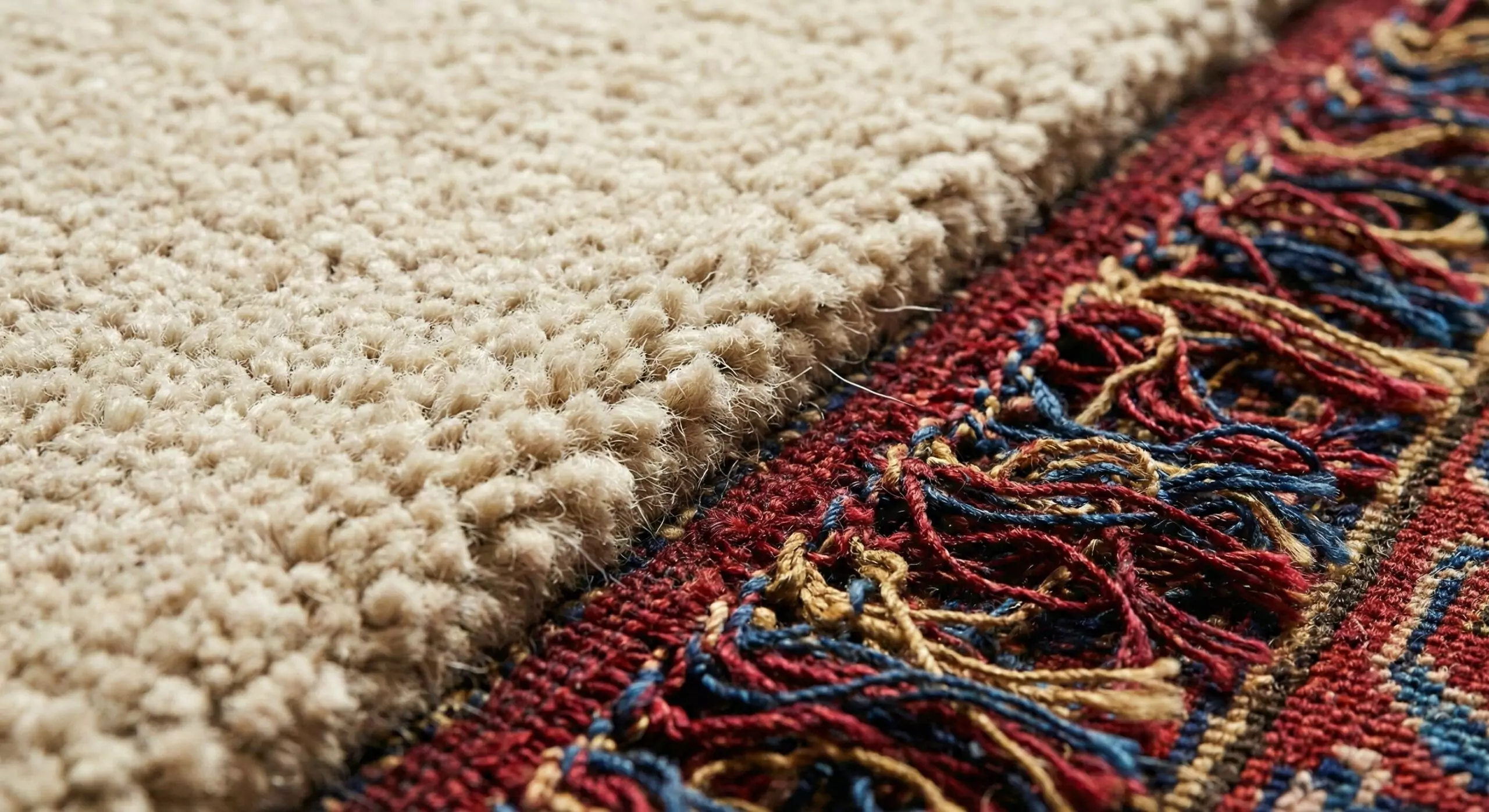
The biggest obstacle to putting a rug on a carpet is movement. You might place your rug perfectly in the centre of the room, but after a few days of walking on it, you will notice it has shifted several inches or bunched up against the sofa.
The Science of Rug Creep
This happens due to the pile of the fitted carpet underneath. Carpet pile is not rigid; it has a “nap” or a direction in which the fibres lie. When you walk on the Persian rug, your weight pushes down onto the carpet pile. As you lift your foot, the pile springs back, but because the pile is directional, it pushes the rug slightly in the direction of the nap.
Over hundreds of footsteps, these tiny shifts add up, causing the rug to “walk” across the room. This creates ripples that look messy and pose a significant tripping risk.
The Solution: Selecting the Right Underlay
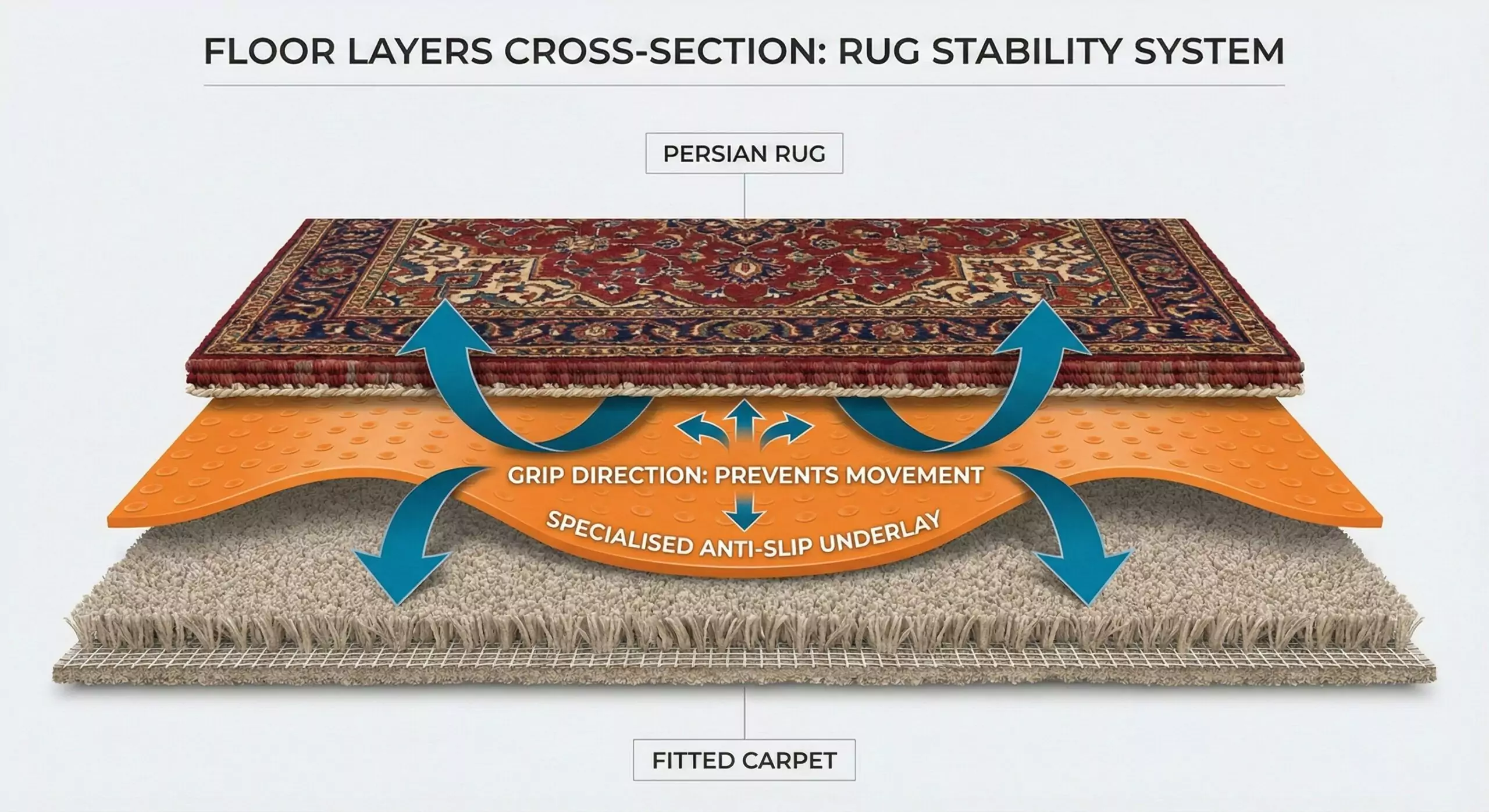
You cannot rely on a standard rubber mat that you would use on a hardwood floor. Those are designed to stick to hard surfaces. For carpet-on-carpet, you need a specialised product.
What to Look For:
- Adhesive-Free / Sticky Felt: You want an underlay that grips the carpet fibres without using glue that leaves a residue.
- Stiffened Surface: A good carpet-under-rug pad is often slightly stiff. This rigidity prevents the Persian rug from collapsing into the soft pile of the fitted carpet, which is the primary cause of bunching.
- Dual-Sided Grip: The underlay needs a rough texture on the bottom to grip the fitted carpet and a tacky surface on top to hold the Persian rug.
How to Install It:
- Measure: Lay your Persian rug out exactly where you want it.
- Cut: Cut the underlay so it is about 3 to 5 centimetres smaller than the rug on all sides. This ensures the underlay does not peek out and allows the rug’s edges to taper down naturally, preventing a trip hazard.
- Place: Lay the underlay on the carpet, then roll the Persian rug over it. Smooth it out with your hands from the centre towards the edges.
Choosing the Right Persian Rug for Layering
Not all rugs sit well on top of carpet. The physical characteristics of the Persian rug play a role in how stable it will be.
Weight Matters
Heavier rugs are generally better for layering. A thick, heavy Persian rug has more mass, which helps pin it down against the fitted carpet.
Lightweight kilims or thin silk rugs are much more prone to rippling because they lack the weight to compress the carpet pile underneath. If you love a thinner rug, you will need a thicker, stiffer underlay to compensate.
The Backing
Hand-knotted Persian rugs typically have a soft, pliable back. This is excellent for longevity, but on carpet, it means the rug bends easily. Machine-made “Persian-style” rugs often have a stiffer jute or latex backing, which actually helps them stay flat on carpet.
If you have a genuine hand-knotted rug, do not compromise its quality, but ensure you use that stiff underlay mentioned previously.
Size and Proportion
A rug that is too small will look like a postage stamp floating in the room and is more likely to slide around.
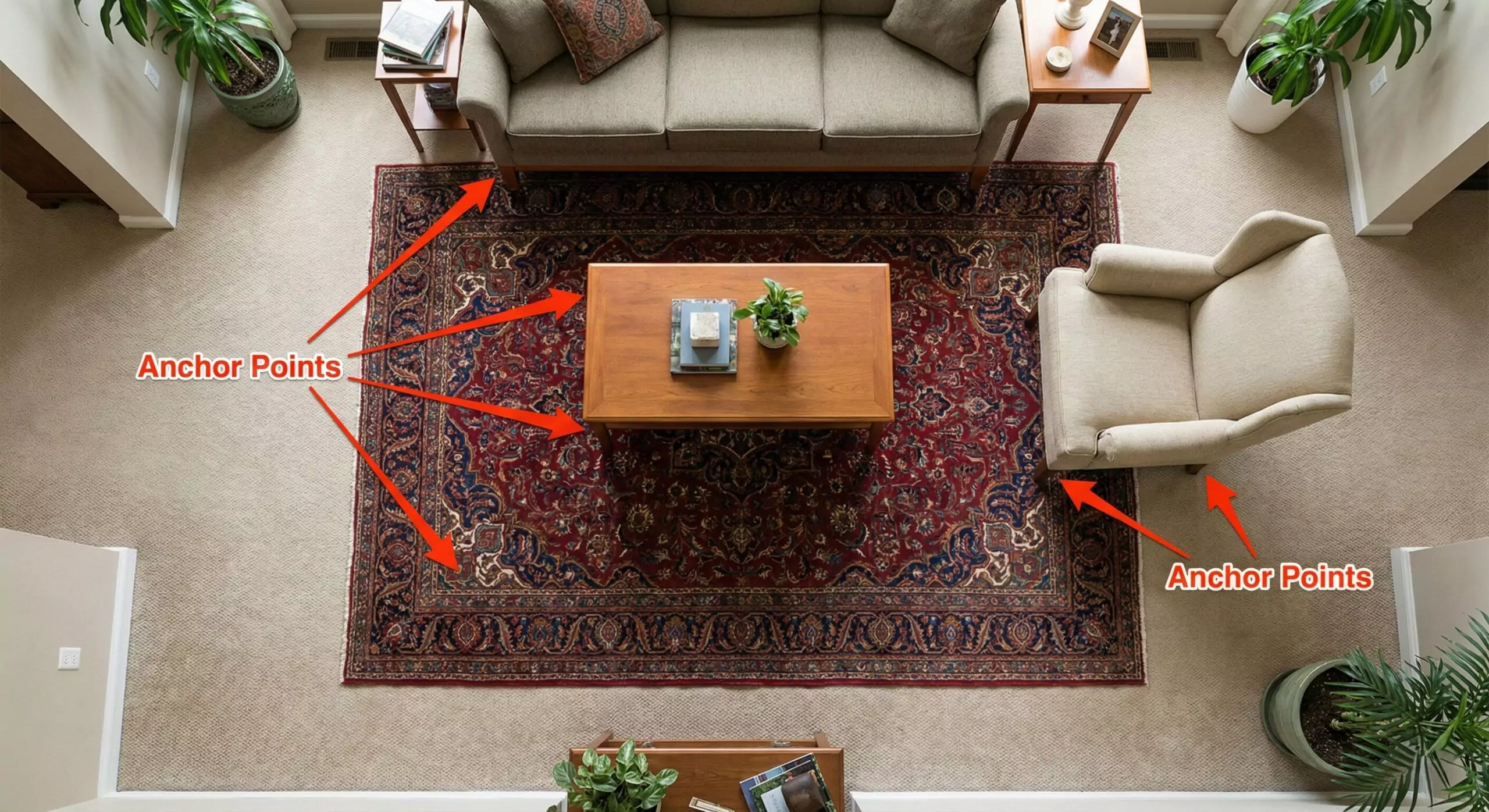
- The Golden Rule: The rug should be large enough that at least the front legs of your major furniture pieces (sofa, armchair) can sit on it.
- Border Space: Ideally, leave a visible border of the fitted carpet around the edge of the rug. This “frame” effect looks intentional and stylish.
Styling Tips: How to Make it Look Good
Once you have solved the mechanical issue of slipping, you need to focus on aesthetics. Layering textures requires a good eye for colour and pattern.
1. Create Contrast
If your fitted carpet is a plain, light beige, almost any Persian rug will look fantastic because the pattern will pop against the neutral background.
- Dark Carpet: If you have a dark grey or navy fitted carpet, choose a Persian rug with lighter tones, creams, golds, or pale blues to lift the room.
- Patterned Carpet: This is tricky. If your fitted carpet already has a pattern, laying a patterned Persian rug on top can look chaotic. In this rare case, it is usually better to avoid layering unless the carpet pattern is extremely subtle (tone-on-tone).
2. Anchor with Furniture
Furniture is your best friend when layering rugs. Placing heavy items on the rug serves two purposes:
- Physical Anchor: The weight of a sofa or a heavy coffee table physically pins the rug down, reducing movement.
- Visual Anchor: It ties the rug to the room, so it looks like part of the sitting area rather than a random rectangle on the floor.
3. Mind the Pile Height
Layering works best when there is a difference in pile types.
- Good Combination: Short-pile or loop-pile fitted carpet (like Berber) works perfectly with a plush Persian rug.
- Bad Combination: A very deep, shag-pile fitted carpet is difficult to layer on. The surface is too unstable, and almost any rug placed on top will shift and buckle, regardless of the underlay.
Maintenance and Care for Layered Rugs
Living with a rug on a carpet requires slightly different maintenance than a rug on a hard floor.
Vacuuming
Vacuuming a floating rug can be annoying because the suction often lifts the edges.
- Technique: Vacuum from the centre of the Persian rug outwards towards the edge. Do not run the vacuum back and forth over the fringe, as this can suck it up and damage the rug.
- Underneath: You must occasionally lift the Persian rug to vacuum the fitted carpet underneath. Dust and grit can sift through the weave of the rug and settle into the carpet below. Over time, this grit acts like sandpaper and can damage the fibres of your fitted carpet. Aim to do this once every few months.
Check for Colour Transfer
Authentic Persian rugs use natural dyes. While rare, there is a risk of dye transfer if a dark red rug gets wet and sits on a light cream carpet.
- Prevention: Ensure your underlay acts as a barrier. If you plan to steam clean the Persian rug, remove it from the room and clean it elsewhere. Do not steam clean a rug while it is sitting on top of your fitted carpet.
Rotate the Rug
Just like any floor covering, rugs wear unevenly depending on where people walk or where the sun hits them. Rotate your Persian rug 180 degrees every six months. This ensures even wear and prevents the fitted carpet underneath from developing a “shadow” line where the rug edge sits.
Frequently Asked Questions
Will the rug damage the carpet underneath?
Generally, no. In fact, it protects the carpet from traffic. However, if the rug has a very rough backing (like rough latex or glue), it could scratch the carpet fibres. A felt underlay prevents this friction damage.
The only other risk is if the carpet underneath fades from sunlight except for the spot covered by the rug, leaving a darker patch of original colour.
Can I put a runner rug on a carpeted hallway?
Yes, hallway runners look excellent over carpet. However, hallways are high-traffic zones, meaning the “creep” effect is stronger here. You must use a high-quality sticky fleece or gripper underlay, or the runner will constantly move.
Is it safe for elderly people?
You must be careful. Layering creates a slight elevation change (a trip hazard). Ensure the rug lies perfectly flat. If the edge of the Persian rug is thick and curled, it may not be suitable for homes with individuals who have mobility issues.
Taping the edges down isn’t usually an option on carpet, so flat-weave rugs or rugs with a low profile are safer choices.
Conclusion
Putting a Persian rug on top of a fitted carpet is a fantastic way to elevate the style of your home. It brings in heritage, artistry, and comfort without the need for renovation. While the physics of carpet-on-carpet can lead to movement, this is easily solved with the correct anti-slip underlay and strategic furniture placement.
Don’t let a beige fitted carpet limit your creativity. By following these steps, choosing the right underlay, anchoring with furniture, and selecting a heavy, quality rug, you can enjoy the timeless beauty of a Persian rug in any carpeted room.
