
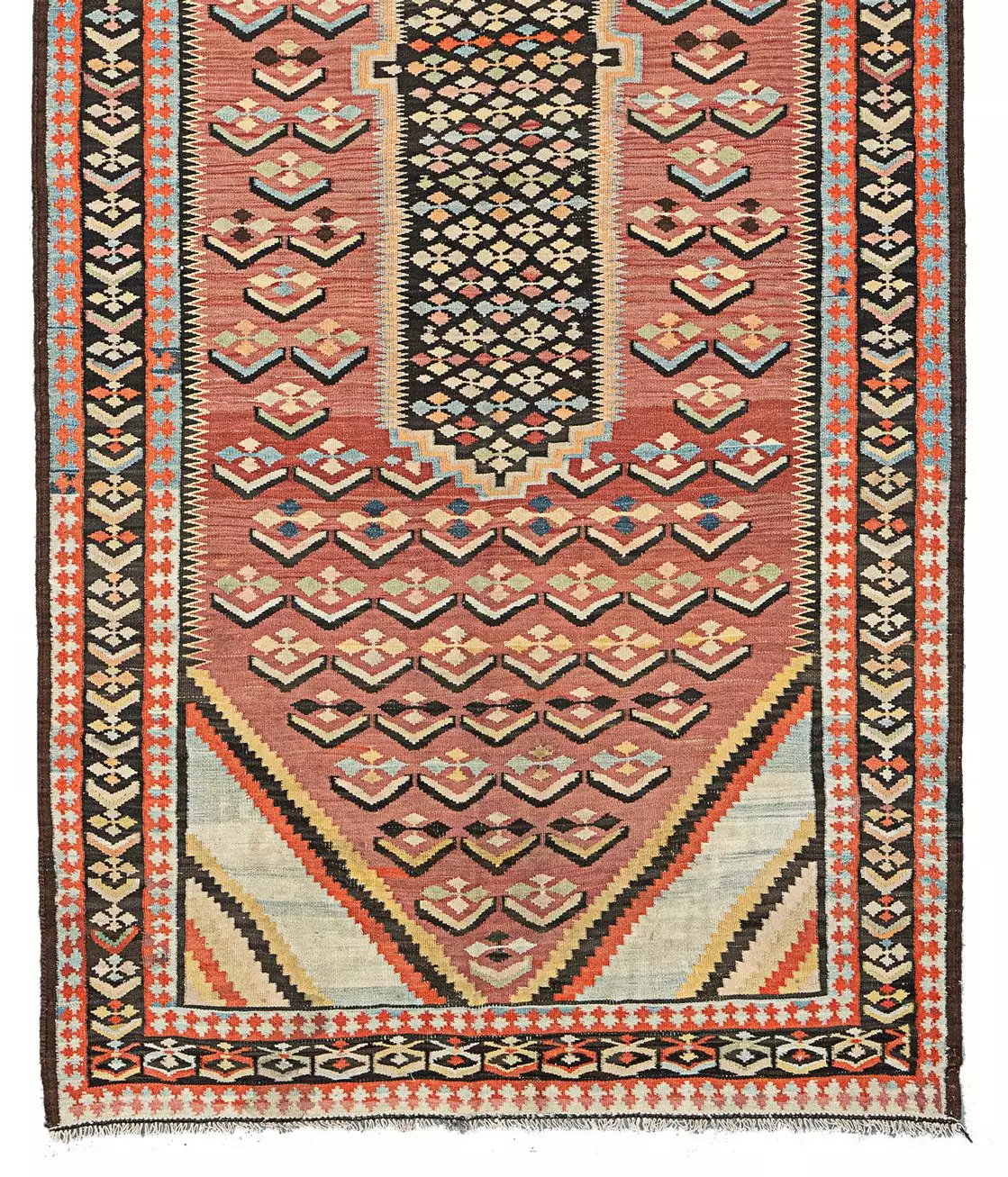
Kilims are made from interlocking warp and weft threads rather than knotting.
Warp: They run North to South. The parallel threads make up the entire length of the rug and provide the base for the knots to be tied.
Weft: They run East to West and make the width of the rug. They are inserted between two rows of knots.
Knot: This term is used for a piece of string that is wrapped around two warps and then cut to form a pile.
Overcasting: A simple yarn that is wrapped around the edges for the entire length of the hand woven rug.
Fringe: The visible continuation of warps at both the loose ends of the Rugs
Different kinds of Kilim Weaving
1. Slit Weaving: The colour of the weft changes from a different wrap to and, and thus, there is no interconnection between different colors, and it makes a little slit between the different colors vertically.
2. Dovetailing: In this type of weave, the end wrap from where the color is supposed to be changed is shared by both the colour of the wefts, as shown in the image, and this prevents the vertical slit.
3. Staggered Dovetailing: It is suitable for the long joins because joins do not form a ridge and are stronger than simple dovetailing. Here, three wraps are used as shown in the following image, and so the distance between the rows is reduced.
4. Single Interlinking: To avoid a slit, the threads are interlinked as shown in the image, but it is necessary to pull them correctly. If pulled too tight, the wraps will be pulled in, while if they are loose, the rug will look very messy and bulky.
5. Curves: Draw the curves on the wraps and then use any of the above techniques to wrap the weft around the wraps according to the drawing.
6. Soumak Weave: This technique of making a Soumak rug uses a certain number of wraps for wrapping the wefts around and then drawing half the number of wraps back. Usually, 4 warps are used, but some soumak rugs also use 2. See the illustration for more clarification.
7. Basket Weave: Check the illustration. It is one of the simplest methods of weaving.
Kilims usually have simple, bold geometric designs.
Kilims are usually all wool and sometimes with a cotton foundation.
They are usually cheaper than piled rugs because they are more straightforward and quicker to weave and take less material than piled rugs of the same size. Consequently, they are lighter than piled rugs and are sometimes used to cover the entrance of tents or the bedding when they are put away.
The flat nature of this textile makes it easier to clean than piled rugs.
They are affordable handmade floor coverings and great value for money. Ideal for introducing colour into a space.
Kilims don’t have the shedding problem that some new piled rugs have.
